


Complete Rubber Mill Rebuilding & Reconditioning
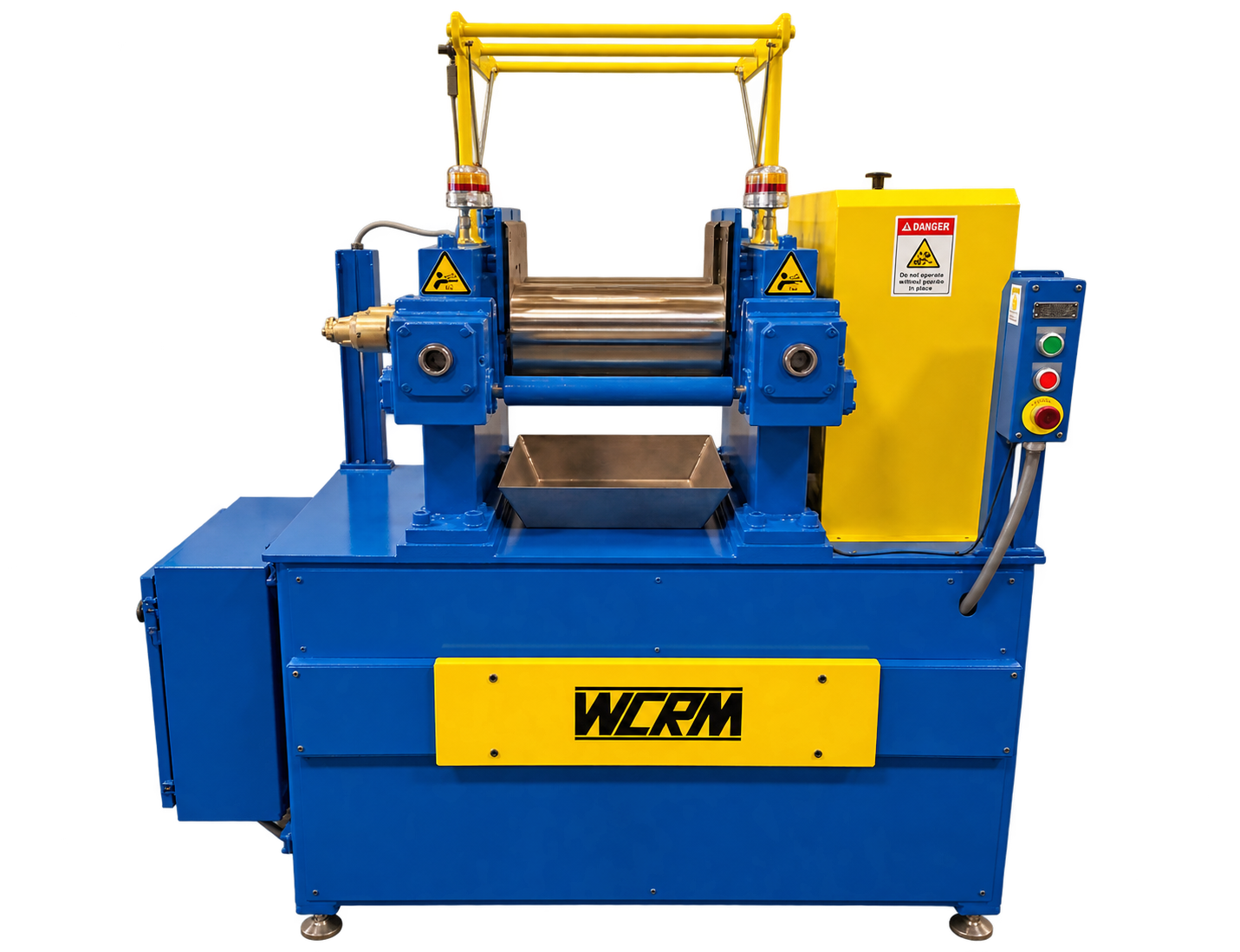
West Coast Rubber Machinery performs complete rubber mill rebuilds for production mills, mixing mills, and lab mills of most makes. A standard WCRM mill rebuild includes full disassembly and inspection, new connecting gears, roll resurfacing with hard chrome plating, new full-circle bronze sleeve bearings, journal repair, safety system upgrades, updated operator controls, and OSHA stopping-distance certification before shipment.


A Complete Scope, Not a Quick Patch
A rubber mill rebuild is not a repair for a single failed component. It is a systematic restoration of everything that affects how the mill runs—rolls, bearings, gears, journals, lubrication, safety hardware, and controls. WCRM’s standard rebuild scope covers:

Complete Disassembly, Cleaning & Inspection
Full teardown, solvent cleaning, and individual component evaluation to identify wear, damage, and items requiring replacement—including issues not visible during operation.
New Connecting Gears
Replacement gears furnished and installed. Gearbox reducer, high-speed and low-speed couplings inspected and evaluated.
Roll Resurfacing & Hard Chrome Plating
Rolls pre-ground, hard chrome plated per AMS-2460 (0.005″–0.007″ thickness), finish-ground, and polished to 20 RMS surface finish.
Journal Repair & Lathe Polishing
Roll journals machined and polished as required to restore dimensional accuracy and the surface condition needed for proper bearing fit and running clearance.
New Bronze Sleeve Bearings
Four new full-circle bronze sleeve bearings, machined to fit for proper running clearance and fitted with grease pockets.
Roll Adjusting Screw Refurbishment
Refurbished as required. Safety crush caps fabricated and installed with spare crush caps supplied.
Lubrication System Service
Grease dispensers inspected and cleaned. Rotary unions inspected; dispersion pipes replaced as required.
Stock Guides
New black Nylatron flip-up stock guide inserts and mechanisms furnished and installed.
Vibration Isolation Footpads
New footpads furnished and installed.
Safety System Upgrades
Emergency stop brake inspected and adjusted. Overhead rocker bar / safety-stop switch furnished and installed per OSHA requirements.
New Operator Control Stations
Front panel with Start, Stop, Emergency Stop, Jog/Reverse, and roll speed potentiometer. Rear panel with Start, Stop, Emergency Stop, and Jog/Reverse.
OSHA Certification Before Shipment
Stopping-distance testing performed, certified, and documented. Safety mechanisms fully tested and operational before the machine ships.
New or Rebuilt to Your Requirements
Transport to Our Facility: The customer handles rigging for loading, transport to WCRM, and rigging for off-loading. We provide guidance on what carriers need for heavy equipment.
Intake & Teardown Planning: On arrival, the machine is documented and teardown planning begins. Condition at intake sets expectations for scope.
Disassembly & Inspection: Complete teardown and cleaning. Hidden wear and damage are identified—often revealing issues that were not apparent from the outside.
Rebuild & Fabrication: Components are repaired, replaced, or fabricated in-house. Roll plating, bearing machining, journal polishing, and gear replacement all performed on-site.
Reassembly & Testing: Machine reassembled, safety systems tested, and stopping distance certified per OSHA requirements. Final documentation compiled.
Shipment: Machine ships with full rebuild documentation and OSHA safety certification.
Signs Your Mill May Need a Rebuild
A rebuild is worth considering when the core machine structure is sound but the wear components, support systems, and safety hardware need serious attention. Common indicators:
Worn or Damaged Rolls: Surface condition affecting how compound processes in the nip.
Journal Wear: Affecting bearing fit, running clearance, and roll tracking under load.
Bearing Problems: Excessive play, heat, or noise pointing to bearing wear or failure.
Gear Damage: Backlash, noise, or inconsistent friction ratio.
Worn Safety or Control Components: Emergency stops, rocker bars, or operator controls not meeting current standards.
Increasing Maintenance Frequency: Recurring failures in components that should have longer service intervals.
Frequently Asked Questions
Do you rebuild mills from manufacturers other than WCRM?
Yes. We rebuild rubber mills from most major manufacturers. The process is based on restoring the machine to its design specifications rather than requiring proprietary access.
Can a rebuilt mill match new mill performance?
A properly rebuilt mill—with new rolls, bearings, gears, and restored journals—can return to OEM-level performance in the critical systems that determine milling quality. In some cases, safety and control upgrades actually exceed the original machine’s specification.
What if additional issues are found during teardown?
We document everything found during inspection and discuss scope changes with you before proceeding. Teardown often surfaces issues not visible externally, and addressing them during the rebuild is far less expensive than dealing with them after the machine is back in production.
What information helps with a rebuild quote?
Mill manufacturer and model, roll diameter and face length, known issues or failure symptoms, and photos of the machine are the most useful starting points.


Ready to Evaluate a Mill Rebuild?
Start the conversation with what you know about your machine—make, model, roll size, and what you are seeing. We will take it from there.