


Rubber Mill Specifications and Configuration Options
WCRM builds and rebuilds two-roll rubber mills across a range of roll sizes and configurations. The specifications below outline the key parameters for production mills, mixing mills, and lab mills. Contact WCRM to discuss requirements outside these ranges or to specify a custom configuration.


Lab Mills
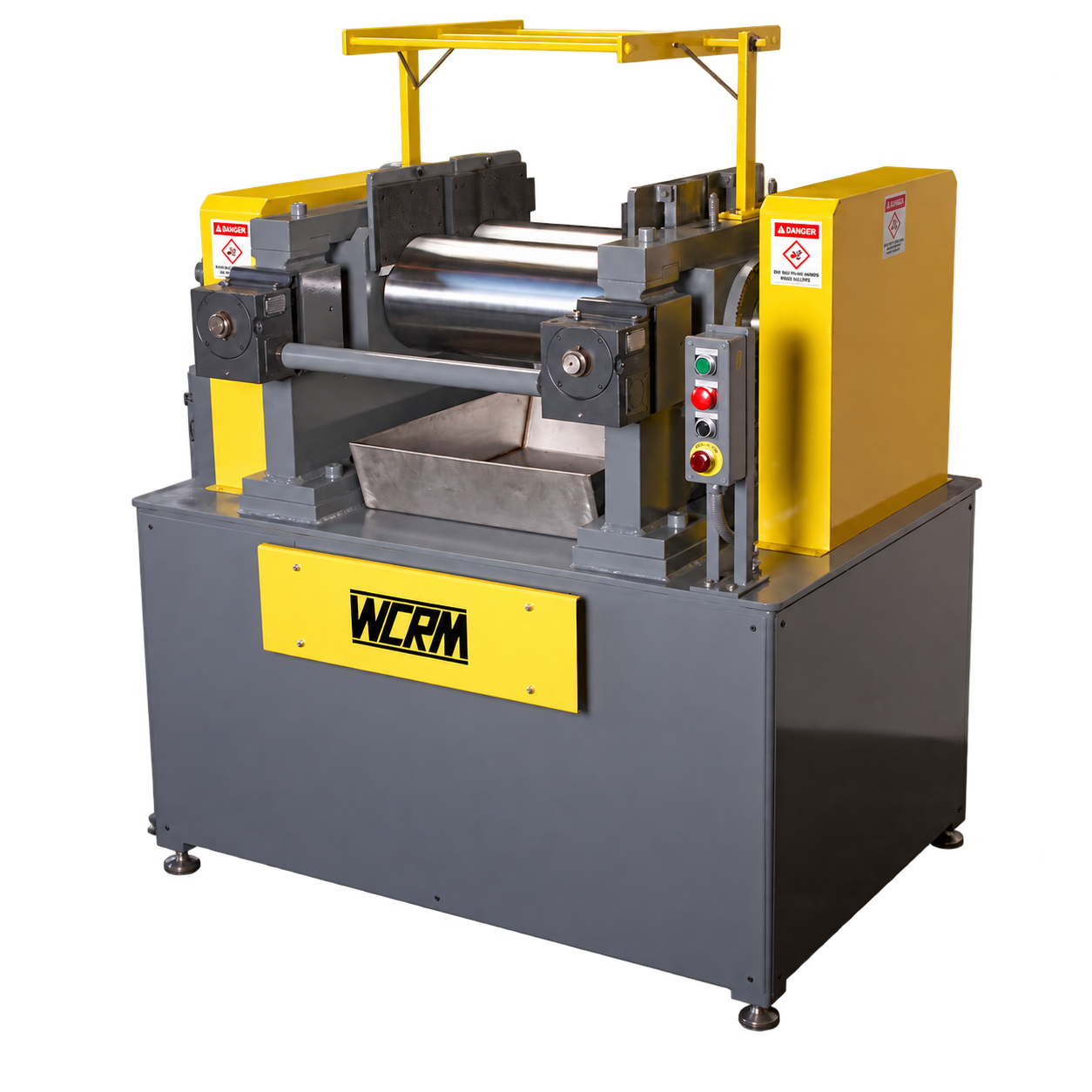
Friction ratio—the speed relationship between the front and back roll—determines shearing intensity and compound behavior in the nip. WCRM mills are available in the following configurations:

Production & Mixing Mills
Fixed friction ratio established by the gear arrangement. Standard production milling typically uses ratios in the range of 1:1.1 to 1:1.5, with 1:1.25 common for general-purpose compounding. Contact WCRM to specify the ratio appropriate for your compounds.
Lab Mills
Selectable fixed friction ratios of 1.00, 1.12, 1.25, or 1.40 to suit the range of compounds used in development and QC work.
Independent Roll Drives
Available for mills where the friction ratio must be adjustable rather than fixed. Allows ratio to be changed based on compound and process requirements without mechanical gear changes.
Roll Dimensions and Capacity
| Mill Type | Roll Diameter | Roll Face Length | Drive HP range |
| Production Mills | |||
| Mixing Mills | |||
| Lab Mills |
Drive Configuration Options
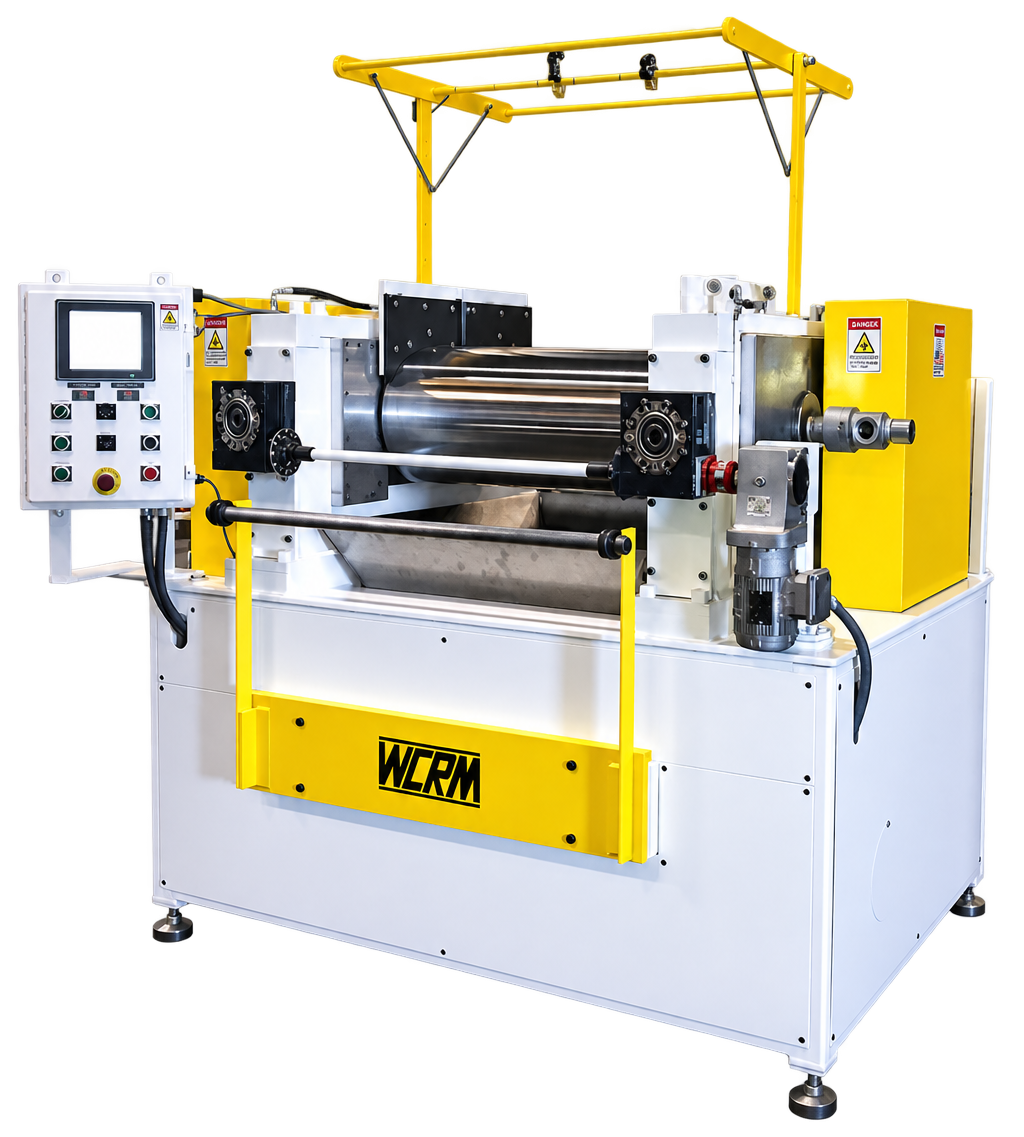
- Fixed Speed Drive: Standard gear-reduced drive at fixed roll speed. Appropriate for operations running consistent compounds with stable speed requirements.
- VFD (Variable Frequency Drive): Electronic speed control allowing roll speed to be adjusted across a range. Includes soft-start capability. Available on new mills and in many cases as a retrofit during rebuild.
- Motorized Roll Adjustment: Motor-driven nip adjustment replacing or augmenting manual handwheel operation, with digital readout for nip gap indication. Available on production and lab mills.
Mill Roll Construction and Finish
Mill rolls are the most critical wear component in a rubber mill. WCRM supplies new and refurbished mill rolls, and performs complete roll restoration during rebuilds:
- Hard Chrome Plating: Applied per AMS-2460 specification at 0.005″ to 0.007″ thickness for restored surface hardness and wear resistance.
- Surface Finish: Finish-ground and polished to 20 RMS surface finish following chrome plating.
- Journal Condition: Journals lathe-polished to restore surface finish and dimensional accuracy for proper bearing fit and running clearance.
- Roll Materials: Contact WCRM to discuss roll material options for specific compound types or operating temperatures.
Standard Equipment on WCRM Mills
- Bronze Sleeve Bearings: Full-circle bronze sleeve bearings with grease pockets—standard on WCRM production and mixing mill builds and rebuilds.
- Stock Guides: Flip-up Nylatron stock guide inserts to contain compound during the milling cycle.
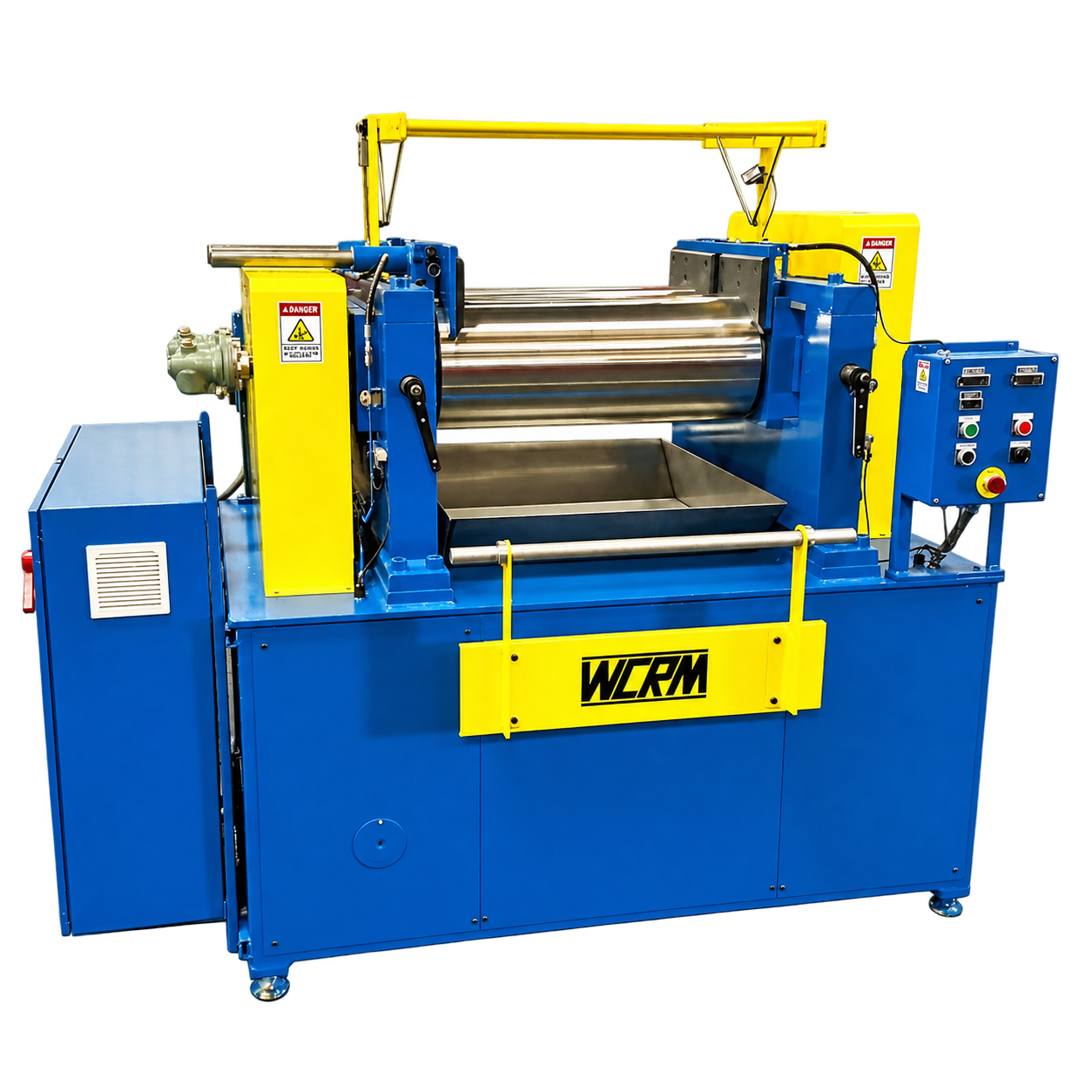
- Overhead Rocker Bar: OSHA-required safety-stop switch installed per applicable safety requirements.
- Operator Control Stations: Front and rear operator panels with start, stop, emergency stop, and jog/reverse controls. Roll speed potentiometer on front panel where applicable.
- Vibration Isolation Footpads: Installed to reduce transmitted vibration and improve machine stability.
- OSHA Safety Certification: Stopping-distance testing, certification, and documentation completed before every rebuilt mill ships.


Ready to Specify Your Mill?
The specifications above are a starting point. Tell us your roll size, compound types, throughput requirements, and any specific operational needs and we will work with you on the right configuration.