


Mill Roll Replacement & Refurbishing
West Coast Rubber Machinery supplies new and refurbished mill rolls for rubber production mills, mixing mills, and lab mills. WCRM refurbishes rolls in-house: pre-grinding, hard chrome plating, finish grinding, and polishing. Journal repair and polishing are performed as part of the same service. Replacement rolls are available for mills from most major manufacturers.


What Roll Refurbishing Involves
A mill roll that has worn, been scored, or lost its surface finish is no longer doing its job properly. The surface condition of the roll directly affects how rubber compound contacts the roll, how heat transfers, and how the compound tracks through the nip. WCRM’s roll refurbishing process restores rolls to a condition that supports reliable milling:
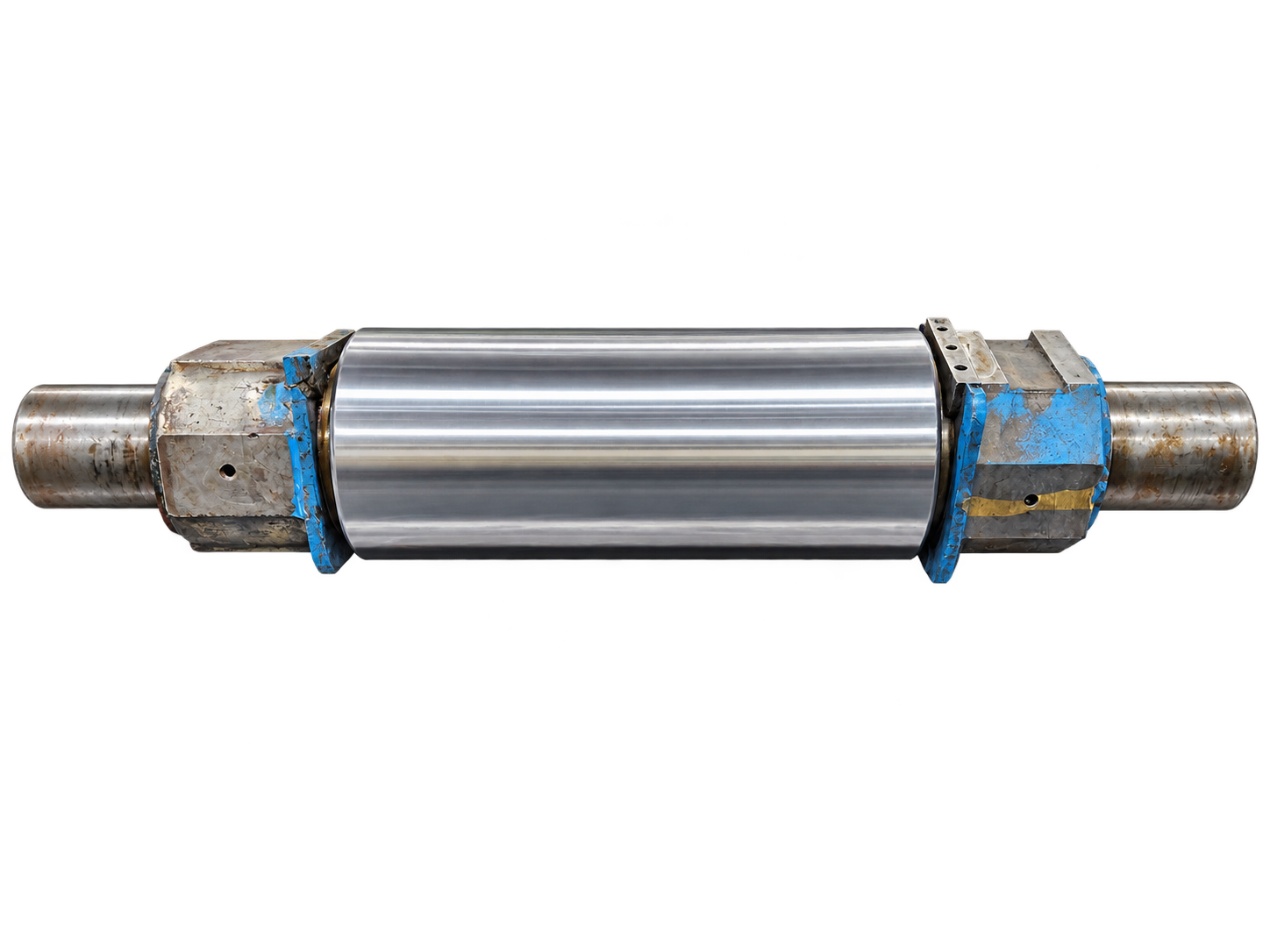

Pre-Grinding
Initial grinding to remove surface damage, wear, and irregularities, and to establish a uniform base for chrome plating.
Hard Chrome Plating
Chrome applied on new rolls at 0.005″–0.007″ thickness per AMS-2460 specification for restored surface hardness and wear resistance.
Finish Grinding
Post-plating grinding to final dimensions, removing plating irregularities and establishing the correct roll diameter.
Polishing to 20 RMS
Final polish to 20 RMS surface finish for consistent compound contact and release characteristics.
Journal Inspection & Repair
Roll journals inspected for wear and damage. Lathe polishing performed as required to restore surface finish and dimensional accuracy for proper bearing fit.
Roll Bearing Inspection and Replacement
Bronze sleeve bearings inspected for wear and running clearance, and replaced as required to restore proper roll fit and tracking. Available with roll refurbishing or as a standalone service.
When Refurbishing Is Not Enough
Some rolls have worn beyond the point where refurbishing restores them to usable condition—excessive diameter loss, deep scoring, or structural damage. In these cases, WCRM supplies new replacement rolls machined to the dimensions of the original. We also supply rolls with modified dimensions when the production process benefits from a change in roll diameter or face length.
New Rolls
Manufactured in-house to your roll diameter, face length, and journal dimensions. Hard chrome plating and finish grinding applied to specification before shipment.
Replacement Rolls for Most Makes
We supply replacement rolls for rubber mills from most major manufacturers. Provide the roll size and dimensions and we will confirm what we can supply. Diameters from 4″ to 24″ and lengths from 8″ to 84″.
Roll Replacement or Full Rebuild?
Roll replacement is appropriate when the rolls themselves are the primary problem and the rest of the mill—bearings, gears, journals, drive components, safety hardware—is in acceptable condition. When rolls are worn but the rest of the machine also shows significant wear, doing rolls alone often means addressing the same machine again sooner than expected. A full rebuild handles rolls, bearings, gears, and the rest of the mill in one scope of work, which is usually the more economical path for a mill with accumulated wear.
Engineering FAQ
What information do I need to request a roll quote?
Mill make and model, current roll diameter and face length, journal diameter and length, and the current surface condition of the rolls. Photos are helpful. If you know the original roll specification, include that as well.
Can rolls be refurbished more than once?
Yes, within limits. Each refurbishment removes some material from the roll diameter. There is a minimum usable diameter below which the roll can no longer be used in the mill. We evaluate remaining refurbishment potential as part of the initial assessment.
Do you repair journals separately from rolls?
Journal repair is typically performed as part of roll refurbishment or during a full mill rebuild. Contact us to discuss if you need journal work without a full roll refurbishment.
How long does roll refurbishment take?
Turnaround depends on roll size and current shop schedule. We provide a timeline with the quote and work to minimize your downtime.


Get a Roll Quote
Tell us your mill make, roll size, and current condition and we will let you know what your options are—refurbishment, new replacement rolls, or a full rebuild evaluation.