


Production Rubber Mills Built for Continuous-Duty Operation
West Coast Rubber Machinery manufactures and rebuilds two-roll production rubber mills for industrial rubber compounding. WCRM production mills are available new or rebuilt, with options for VFD speed control, powered roll adjusters, stock guides, and independent roll drives. New and refurbished mill rolls, bearings, and replacement parts are also available to keep existing mills running.


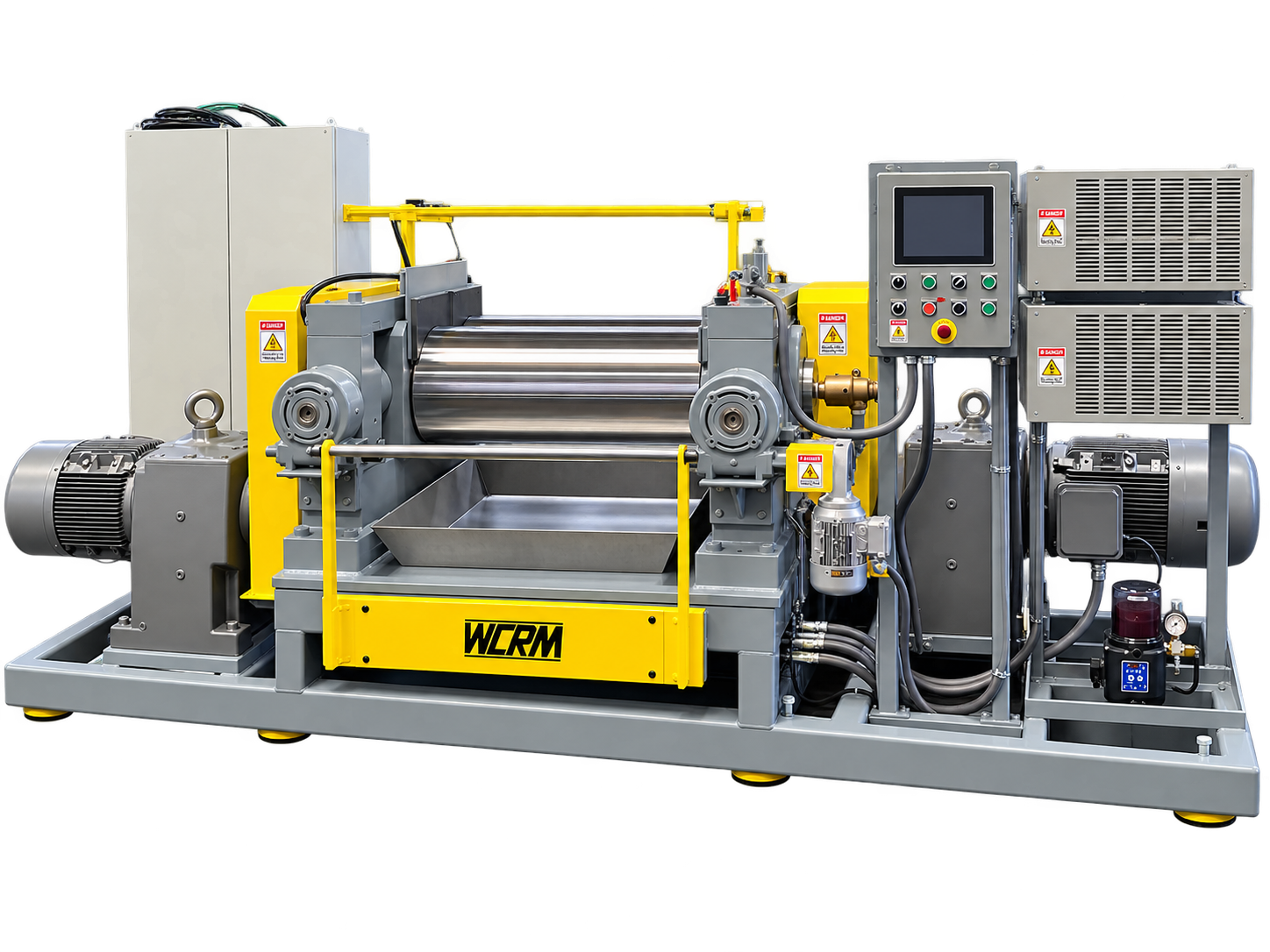

Two Rolls, a Nip, and Decades of Proven Processing
A two-roll rubber mill consists of two horizontal rolls rotating toward each other at different surface speeds—a friction ratio typically in the range of 1:1.1 to 1:1.5. The speed differential creates shearing action as rubber compound passes through the nip, which drives mixing, dispersion, and plasticization. The compound adheres to the faster roll, is folded back, and passes through the nip repeatedly until it reaches the required consistency and temperature.
Production mill performance depends on roll surface condition, bearing integrity, drive consistency, and the accuracy of the friction ratio. As these components wear, milling consistency declines. That is why WCRM’s rebuild program exists: to restore worn mills to the condition that reliable production depends on.
Standard Configuration and Available Options
WCRM production mills are built with the core mechanical systems required for reliable continuous-duty operation. The following options can be incorporated into new mill builds and in many cases added to existing mills during a rebuild:
VFD Speed Control
Variable frequency drive for adjustable roll speed across a broader range than fixed-speed systems. Allows speed to be matched to compound requirements; reduces mechanical stress during startup; improves energy efficiency under partial load.
Powered Roll Adjusters
Motor-driven roll gap adjustment with digital nip readout replaces manual handwheel operation, providing more repeatable nip settings between batches and reducing operator effort on mills with frequent gap changes.
Stock Guides
Flip-up Nylatron stock guide inserts direct compound during the milling cycle, reducing material migration toward roll ends and minimizing operator intervention to reposition the bank.
Independent Roll Drives
Separate drive motors for each roll allow the friction ratio to be adjusted for different compounds or processes rather than being fixed by the gear arrangement.
Bronze Sleeve Bearings
Full-circle bronze sleeve bearings with grease pockets are standard on WCRM production mills and rebuilds—selected for their ability to handle the shock loads and lubrication conditions of heavy production milling.


New Construction or Full Rebuild—Your Choice
New WCRM Production Mills
Built to your roll size and configuration requirements with your choice of drive, speed control, and operational options.
Complete Mill Rebuilds
Full teardown, inspection, new gears, hard chrome-plated and finish-ground rolls (AMS-2460, polished to 20 RMS), new bronze bearings, journal repair, lubrication system service, safety upgrades, operator controls, and OSHA-certified testing before shipment.
Mill Rolls & Replacement Part
New and refurbished mill rolls, replacement bearings, and other components available for mills requiring targeted repair rather than a full rebuild.
Engineering FAQ
What friction ratio do WCRM production mills use?
Most production mills run with a fixed friction ratio in the range of 1:1.1 to 1:1.5, with 1:1.25 being common for general-purpose production milling. Mills with independent roll drives allow the ratio to be adjusted. Contact WCRM to discuss the right configuration for your compound and process.
What is the difference between bronze and roller bearings for production mills?
Bronze sleeve bearings handle the shock loads and lubrication conditions of heavy production milling better than roller bearings in most cases. They are the standard choice for WCRM production mill builds and rebuilds. Roller bearings are more common in lab and precision environments where cleanliness and low friction are priorities.
Can I add VFD or powered roll adjustment to an existing mill?
In many cases, yes—but feasibility depends on the existing drive configuration and the overall condition of the machine. Adding a VFD or motorized adjustment to a mill with significant underlying wear may surface issues that were not apparent at fixed speed. WCRM evaluates the full drive arrangement when discussing retrofits rather than treating them as standalone upgrades.
What information do I need to provide for a quote?
Roll diameter, roll face length, drive configuration, and the production requirements the mill needs to meet are the most useful starting points. Photos of existing equipment are helpful if you are evaluating a rebuild.


Ready to Talk About Your Production Mill?
Whether you need a new mill, a complete rebuild, or replacement rolls and parts, tell us your roll size and production requirements and we will work from there.