


Rubber Mixing Mills for Compound Preparation and Batch Blending
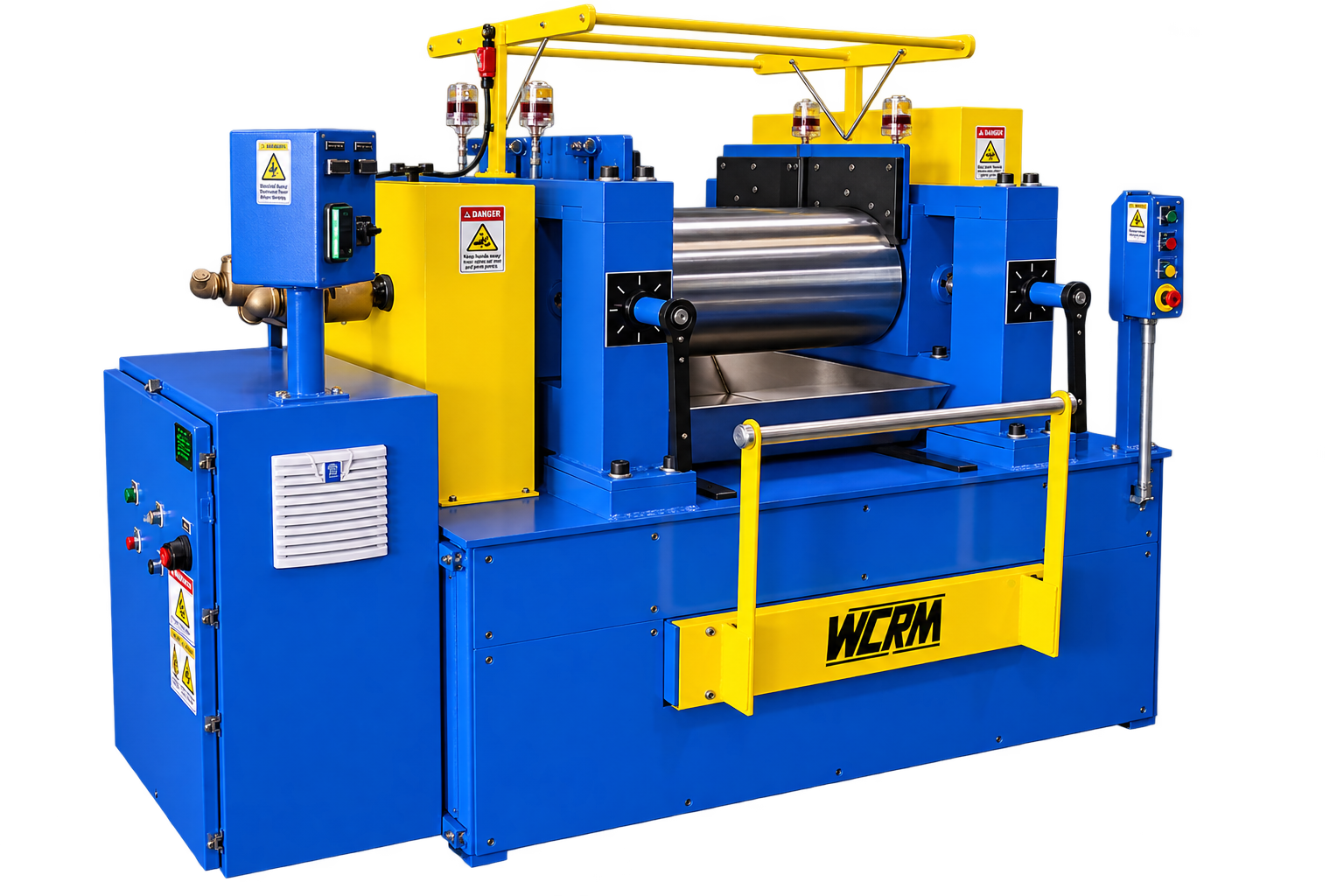
West Coast Rubber Machinery supplies two-roll rubber mixing mills for compound preparation—incorporating fillers, curatives, plasticizers, and other ingredients into rubber batches. Available new or rebuilt, WCRM mixing mills are configured for the throughput, compound types, and operational requirements of each application. Rebuild and repair services are available for existing mixing mills.



Where Mixing Mills Fit in the Rubber Processing Line
Mixing mills are used to incorporate and disperse ingredients into rubber compounds—either as an open-mill step following internal mixer dump or as a standalone mixing operation for smaller batches. The shearing action of the two-roll nip breaks down agglomerates, distributes fillers, and allows curatives and other late-addition ingredients to be incorporated uniformly before the compound goes to molding or extrusion.
Temperature control is critical during mixing. Running too hot risks premature cure activation of the curatives being added. Running too cold limits plasticity and makes thorough dispersion difficult. Mixing mill roll cooling or heating and attention to batch size relative to roll face length are key variables in a consistent mixing operation.
Built for the Demands of Open-Mill Mixing
Friction Ratio
Mixing mill friction ratios are typically set to generate sufficient shear for effective dispersion—the right ratio for your compounds is part of the configuration discussion.
Roll Cooling & Heating
Roll temperature control systems allow the processing temperature to be managed throughout the mixing cycle, reducing the risk of scorch during curative addition.
VFD Speed Control
Variable speed capability to match roll speed to compound viscosity and mixing intensity requirements for different batches.
Stock Guides
Flip-up stock guide inserts to contain compound within the working area of the roll face during open mixing cycles.
Powered Roll Adjustment
Motorized nip adjustment with digital readout for repeatable gap settings during multi-stage mixing operations.
Safety Systems
Emergency stop, overhead rocker bar, operator control stations, and OSHA-compliant stopping-distance certification on rebuilt mills before shipment.
New or Rebuilt to Your Requirements
WCRM manufactures new mixing mills to your roll size and configuration requirements. We also fully rebuild existing mixing mills—including new rolls with hard chrome plating (AMS-2460 spec), new bronze sleeve bearings, journal repair, gear replacement, safety upgrades, and OSHA-certified testing before shipment.
Frequently Asked Questions
What is the difference between a mixing mill and a production mill?
The terminology overlaps—both are two-roll mills with the same basic mechanical design. The distinction is primarily in use: a mixing mill is used for compound preparation (incorporating ingredients into the batch), while a production mill is used for ongoing processing, sheeting out, or warming compound before molding. In practice, many operations use the same style of mill for both.
What roll size do I need for a mixing mill?
Roll diameter and face length should be matched to your typical batch size and throughput requirements. Contact WCRM to discuss your compound types and batch volumes—we can help you identify the right mill size.
Can you rebuild a mixing mill from another manufacturer?
Yes. WCRM rebuilds mixing mills from most major manufacturers. The rebuild process is based on restoring the machine to its design specifications rather than requiring proprietary service access.


Discuss Your Mixing Mill Requirements
Tell us your batch size, compound types, and roll size requirements and we will work with you on the right mill configuration.